

The Most Important Part of Your Landing Page Is the Next Clear Step
For a tint-shop owner already comparing systems, the most important part of a landing page is not the hero photo, a clever headline, or a stack of features. It is whether a ready buyer can understand what to do next without having to restart the conversation in a different tool.
That does not mean a page creates demand by itself. Search, referrals, Maps, social, and reputation may bring someone there. The page's job is narrower and important: make the shop, the service choice, and the next step understandable enough for that existing interest to become a usable quote, inquiry, or booking path.
The buying question
If you are evaluating Tint Bolt, ask this: Can the customer-facing page carry a real tint inquiry into an operating process I can run, without promising more than it can deliver?
For many solo shops, that is the first constraint. A prospect sees a vehicle, film, shade, package, or price question; the owner is installing; and the details are then scattered across texts, a calendar, notes, and a spreadsheet. A landing page is useful when it preserves the decision context rather than just collecting another disconnected message.
What Powerhouse makes possible
Powerhouse is the self-serve operating foundation. It includes a Tint Bolt-hosted shop page with customer-facing service, vehicle, film, shade, install-package, and price configuration, plus quote, inquiry, and booking entry points. Its role is to connect that customer path to the shop's lead, booking, customer, job, warranty, and follow-through context.
The live S3 Tint flow first carries the customer's selected vehicle into the next relevant decision instead of asking them to start over.
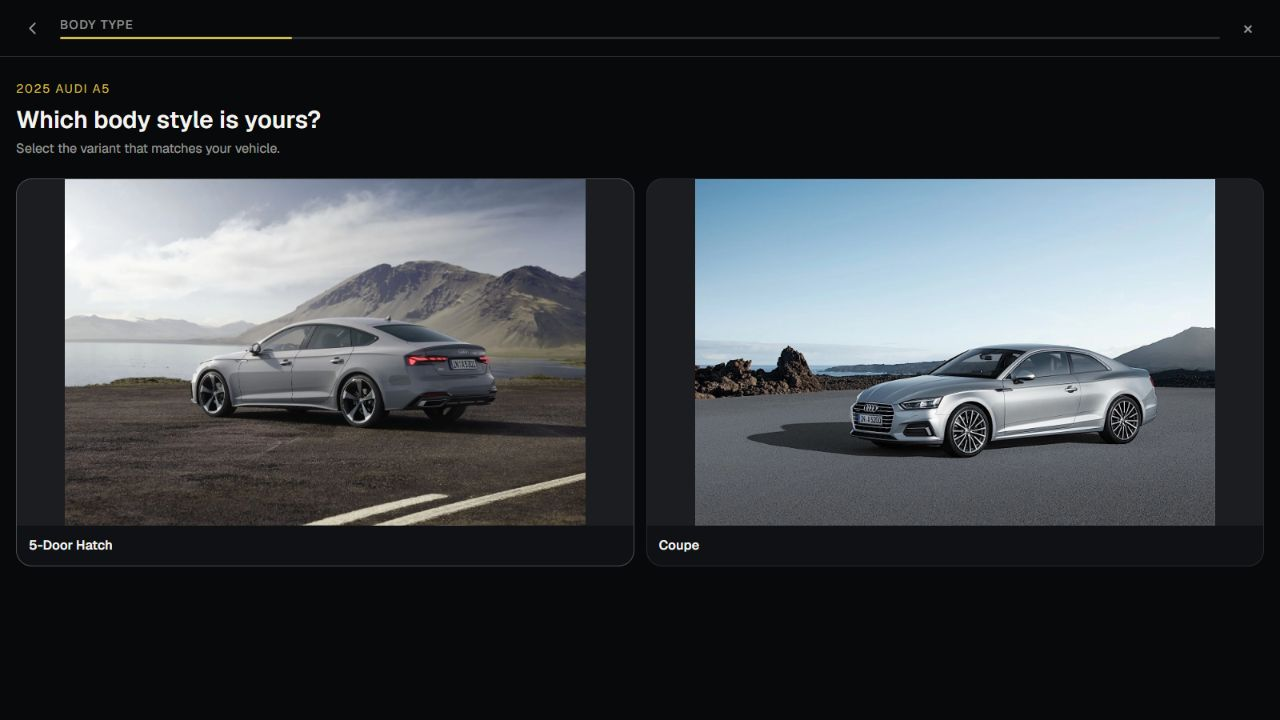
It then presents coverage choices that are specific to that vehicle and preserves the selection as the customer moves forward.
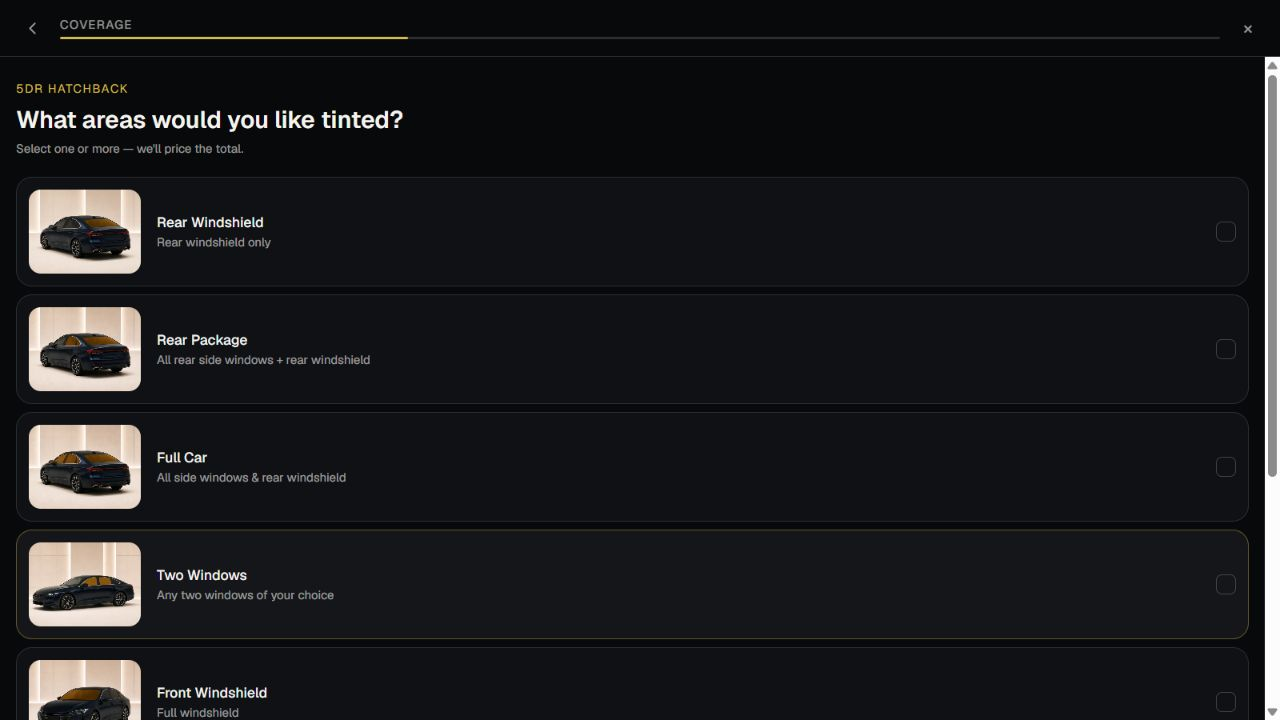
Finally, the quote result keeps the real package price, deposit requirement, vehicle, installation type, and availability action together in one customer-facing step.
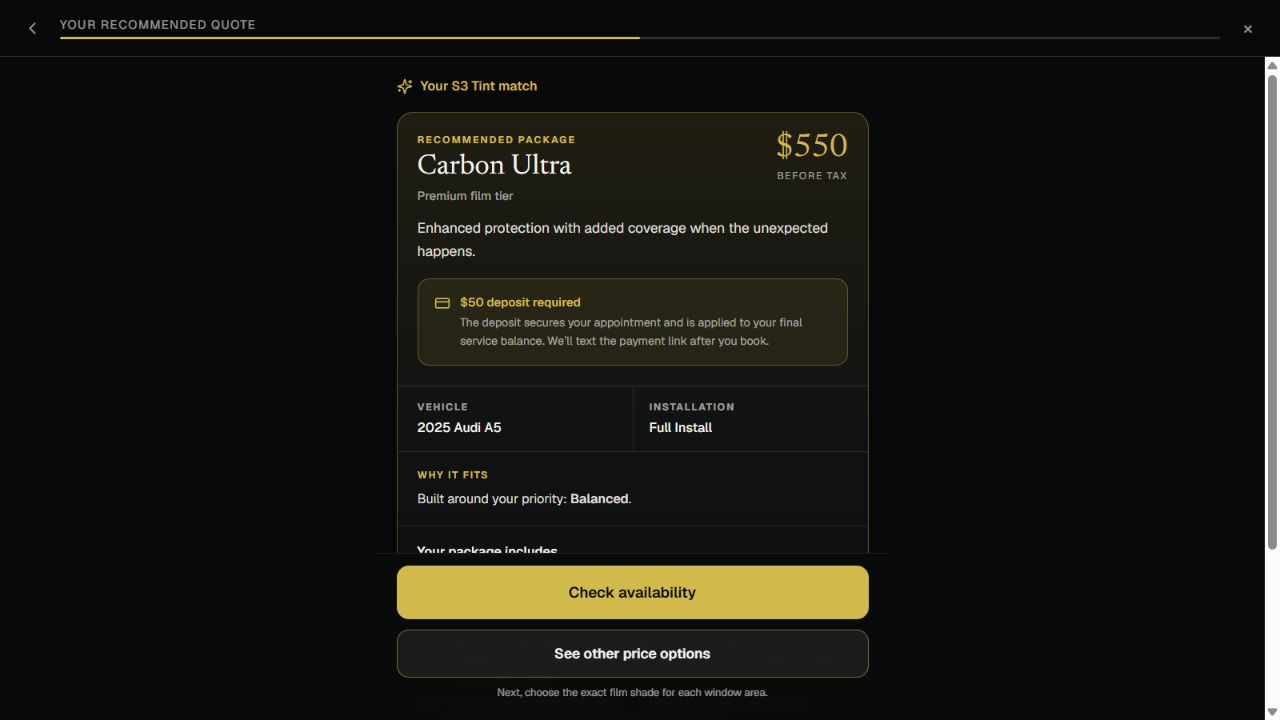
Together, these screens demonstrate how Tint Bolt can preserve useful decision context instead of forcing the customer to restart in a generic inquiry. They are not proof of traffic, conversion, revenue, or fewer no-shows. Those outcomes depend on the shop's offer, service information, availability, communication, and the demand it earns elsewhere.
Powerhouse is usually the right fit when your next improvement is a repeatable core process: clear services and prices, a customer quote path, booking rules, connected records, and a place to review the resulting work. The owner still supplies accurate services, taxes, policies, availability, customer consent, and final promises. Provider-dependent payments, SMS, email, calendar connections, and tracking need their applicable accounts, credentials, rules, and configuration.
When a hosted shop page is enough
A hosted page is not a compromise when the actual problem is operational consistency. It is a practical starting point for a shop that does not need a custom-domain engagement yet. Powerhouse is a poor fit if you only want advertising, only want a generic calendar link, or do not intend to standardize the customer process. It is also not a promise that a website will be found or that every inquiry will book.
Its current price is $50 per month or $500 per year through authenticated Stripe checkout. Verify the live product page, checkout availability, and terms at the time of purchase.
When the page itself needs to be a deeper decision surface
Shadow includes the Powerhouse foundation, then adds a founder-scoped custom site and domain with Tint Bolt quote and booking built into that experience. The live S3 Tint sequence demonstrates an inline quote path inside a custom customer property. This article intentionally does not repeat the generic custom-site and executive-dashboard screenshots used in the plan-comparison article; those product capabilities remain grounded in the verified product documentation and do not prove a business result.
Shadow is for an owner whose core services, prices, booking rules, and records are stable enough to measure, and who needs a custom customer experience plus deeper cost, offer, executive, attribution, partner, or growth visibility. It is not simply Powerhouse with more buttons.
The boundary matters. Custom site scope is agreed during founder review; it is not unlimited website design, copywriting, SEO, or agency work. Attribution can be incomplete when links, identifiers, devices, or real-world handoffs break the tracked path. Financial outputs depend on complete and correctly categorized inputs. Shadow provides decision support, not professional accounting, tax, legal, or financial advice, and it does not make advertising, partner management, prices, budgets, or customer commitments autonomous.
Shadow is currently $2,500 annually, with no monthly self-serve checkout. The path is application, founder fit and scope review, cleared payment, then activation and implementation. Re-check the live application and agreed scope before committing.
The practical landing-page checklist
Before choosing a plan, look at your own page and ask:
- Can a visitor identify the relevant service, vehicle, film, package, and next step?
- Does the next step carry useful context into quote and booking work, or create another isolated conversation?
- Are services, prices, availability, policies, and customer-facing claims accurate enough to publish?
- Is the constraint a dependable core path, or do you genuinely need a custom domain and deeper operating insight?
- Are you prepared to maintain the information and review the results rather than treating the page as an autonomous salesperson?
If the answer is a dependable, connected core path, evaluate Powerhouse. If the core is already dependable and the custom customer experience plus deeper decision layer are necessary, apply for a Shadow fit review. Make the smallest complete decision that solves the constraint you have now—not the biggest feature list.