
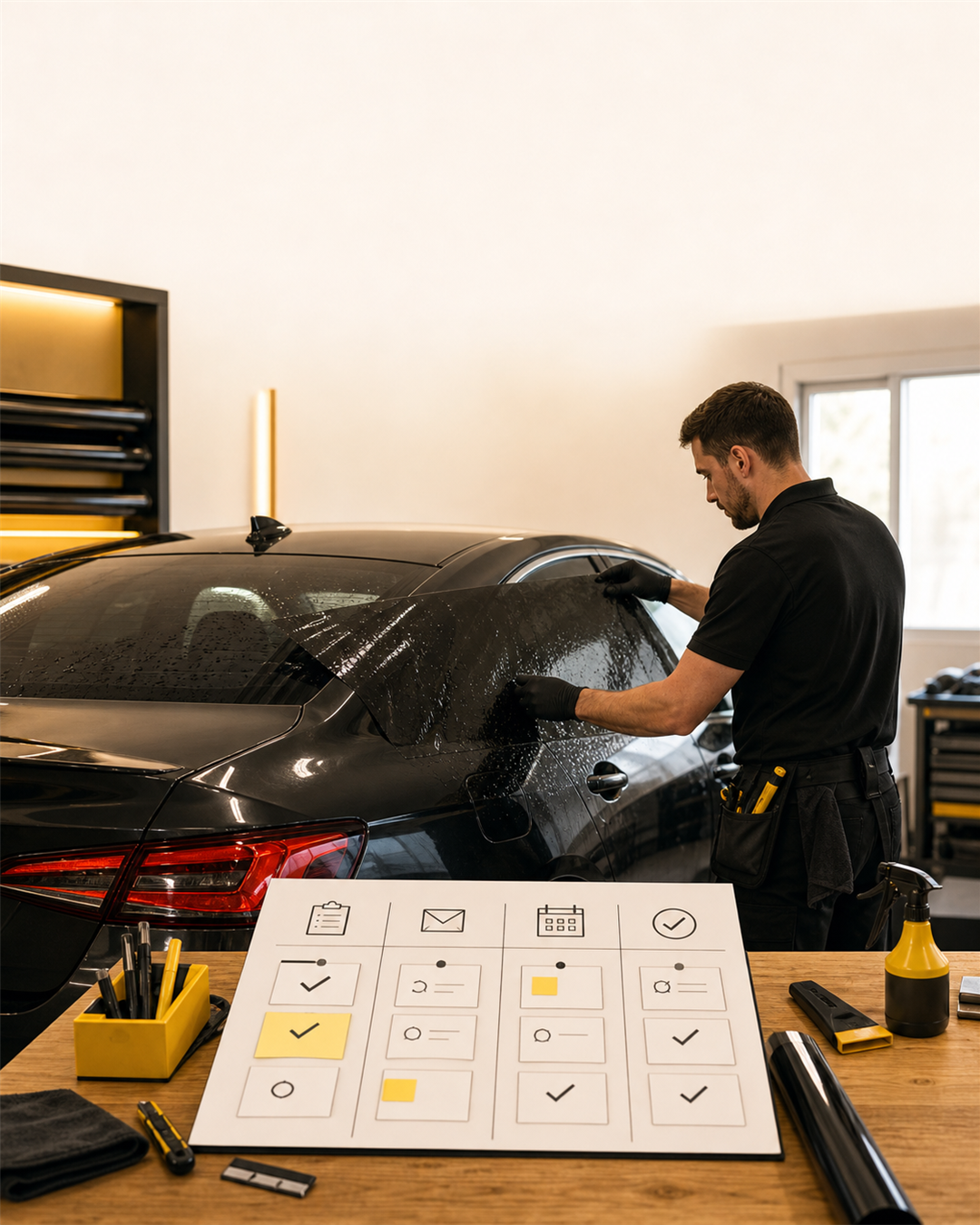
What should a growing tint shop automate before hiring its first service advisor?
Automate the repeatable handoffs before you hire: acknowledge an inquiry, collect the same basic job details, keep one current booking record, show only real availability, send confirmation and preparation information, and create a task when a human decision is due. Keep recommendations, unusual vehicles, price exceptions, complaints, and any promise that affects the install personal. The goal is not to make a tint shop “hands-off.” It is to stop a skilled owner from rebuilding the same context in DMs, texts, calendars, and memory.
Before adding staff, run the audit at the end of this article for one week. It will show whether you need another person for judgment and relationships—or a clearer process for routine coordination. Tint Bolt’s current product position is practical: organize quoting, booking, customer context, follow-up, and reporting in one maintained automotive-tint platform; it does not promise an autonomous sales agent or replace owner judgment.
1. Split the work by decision, not by channel
Messages, calls, Instagram DMs, a calendar, and a paper notebook are channels. They do not tell you whether work deserves a person. Use a simpler test: would the answer change because a skilled tinter understands this particular customer or vehicle? If yes, keep a human in the loop. If the answer should be the same every time once a rule is set, make it a repeatable step.
Keep these personal: helping a customer weigh film options; checking whether a vehicle or old film needs special handling; deciding whether a price exception is justified; resolving a complaint; and approving any unusual schedule change. These calls need context and accountability.
Systemize the surrounding coordination: an immediate, honest acknowledgement while you are on an install; required contact and vehicle fields; a current quote or service selection; bookable times based on rules you set; the confirmation; preparation instructions; and a visible next action. This is a workflow design choice, not evidence that automation will increase revenue or eliminate a hire.
2. Make one booking record the source of truth
The clearest hiring warning is reconstruction work. Open an inquiry from yesterday. Can you see the customer, vehicle, requested coverage, quoted service, current appointment status, and next action without rereading the entire thread or opening three apps? If not, the first fix is a small shared record.
For a normal automotive tint job, begin with only details that prevent a repeated question or bad handoff: customer name and preferred contact method; year, make, model, and body style; requested coverage; selected service or quote; appointment time and expected duration; commitment status; and an install-relevant note. Add fields only when they change a decision. NIST’s small-business guidance treats information security as a people, process, and technology responsibility; its current quick-start material also frames risk management as something small organizations can tailor to their own priorities. NIST small-business quick-start guides NIST IR 7621
Limit access to the information needed for the job, protect accounts, and avoid copying customer details into personal notes or unrelated tools. The exact privacy obligations depend on where the shop operates and what data it handles; this is operational guidance, not legal advice.
3. Turn availability into rules before you expose it
An empty square on a calendar is not always a tint appointment. A full vehicle, front-two job, removal, difficult back glass, cleanup, lunch, and travel each can make the real duration different. Decide your rules first: which services are bookable, their duration, buffers, maximum jobs, working hours, blocked dates, and which exceptions need review.
Modern scheduling systems commonly support controls such as booking windows, buffers, daily limits, adjusted availability, and conflict checks. Google’s appointment-schedule documentation describes those controls; that is an example of available scheduling patterns, not a recommendation of Google or a claim that a configuration prevents every conflict. Google Calendar appointment schedules Google Calendar conflict guidance
Test the path like a customer. Create a calendar conflict, try to book near a buffer, try an exception date, and confirm that a complex service stops for review if it should. If you would reject a time manually, do not call it “available” online.
4. Automate completion, not a vague conversation
The most useful routine sequence is short: acknowledge, collect the needed facts, offer a valid next step, record the result, confirm the appointment, and send preparation information. Each message should say what it is and what happens next. Do not let “sounds good” mean booked to the customer and tentative to the shop.
Choose one event that makes an appointment real—an explicit acceptance, a completed booking form, a deposit, or another policy you consistently apply—and state it before the customer relies on the slot. Current scheduling products can send confirmations and reminders and can offer cancellation or rescheduling controls; Square documents these as configurable product capabilities. They are not proof that every tint shop needs Square or that reminders prevent no-shows. Square appointment reminders Square cancellation policies
Use automation to carry a complete routine message. Use a person when the customer asks a question, a job falls outside the rules, or the service choice is unclear. An automated acknowledgement should never pretend a quote is complete or a time is confirmed when it is not.
5. Keep service communication separate from marketing
An appointment confirmation, preparation note, or change notice supports an active job. A promotion has a different purpose. Store marketing permission and suppression status separately from booking status so a person who asked about tint is not quietly added to unrelated promotions.
For U.S. commercial email, the FTC says CAN-SPAM requires accurate header and subject information, a clear opt-out method, and prompt honoring of opt-out requests; its guide says an opt-out must be honored within 10 business days. FTC CAN-SPAM compliance guide For certain U.S. calls and texts, FCC rules address consent revocation and state that covered revocations must be honored within a reasonable time, no more than 10 business days. FCC 24-24 These are U.S.-specific sources, not a complete compliance plan for every channel or jurisdiction. Ask qualified local advice before changing a program.
For this campaign, the email derivative is restricted to marketing-opted-in contacts and expects execution-time unsubscribe handling. No message is being sent by this bundle.
6. Hire after the process can explain the job
You may need a service advisor when demand and exception handling exceed your capacity. But hiring does not repair an undocumented process; it can simply move the reconstruction work to a second person. Before hiring, make sure a new teammate could answer, from the record: what the customer asked for, what was offered, what is confirmed, what is due next, and which decisions require the owner.
That gives the first advisor a useful role: protect response quality, maintain the record, follow defined escalation rules, and own approved customer communication—not invent pricing, promise install outcomes, or guess at unusual vehicles. Start with a decision map and a one-week audit rather than a large software rebuild.
One-week automation-before-hiring audit
For every inquiry that reaches quoting or booking this week, mark these eight checks:
- Did the customer receive an honest acknowledgement when you could not reply fully?
- Were vehicle, service, and contact details captured once in a current record?
- Could you see the current stage and next action without reconstructing the thread?
- Did every exposed time reflect real duration, buffers, and exceptions?
- Was the confirmation event clear to both the shop and customer?
- Did routine messages answer a real question without pretending to make a human decision?
- Were marketing permission and service communication kept separate?
- Which repeated task consumed owner attention but required no owner judgment?
Choose one repair from the answers: add a required vehicle field, create a buffer, define a confirmation rule, remove an old booking link, or write one escalation rule. Then observe your own shop before assuming the next answer is a hire or more automation.
If you want a structured way to compare this administrative friction with response, quote-conversion, and no-show leaks, take the free Revenue Leak Report.